METHOD / FROM MODEL TO SPECIFICATION
See the event.
Design the response.
Pressure transients are system events. We model the whole line, identify the governing cases, and test protection until the results become practical design decisions.
Start with the
real pipeline.
Route levels, pipe properties, reservoir boundaries and pump curves establish the steady state. Every transient result depends on this baseline being right.
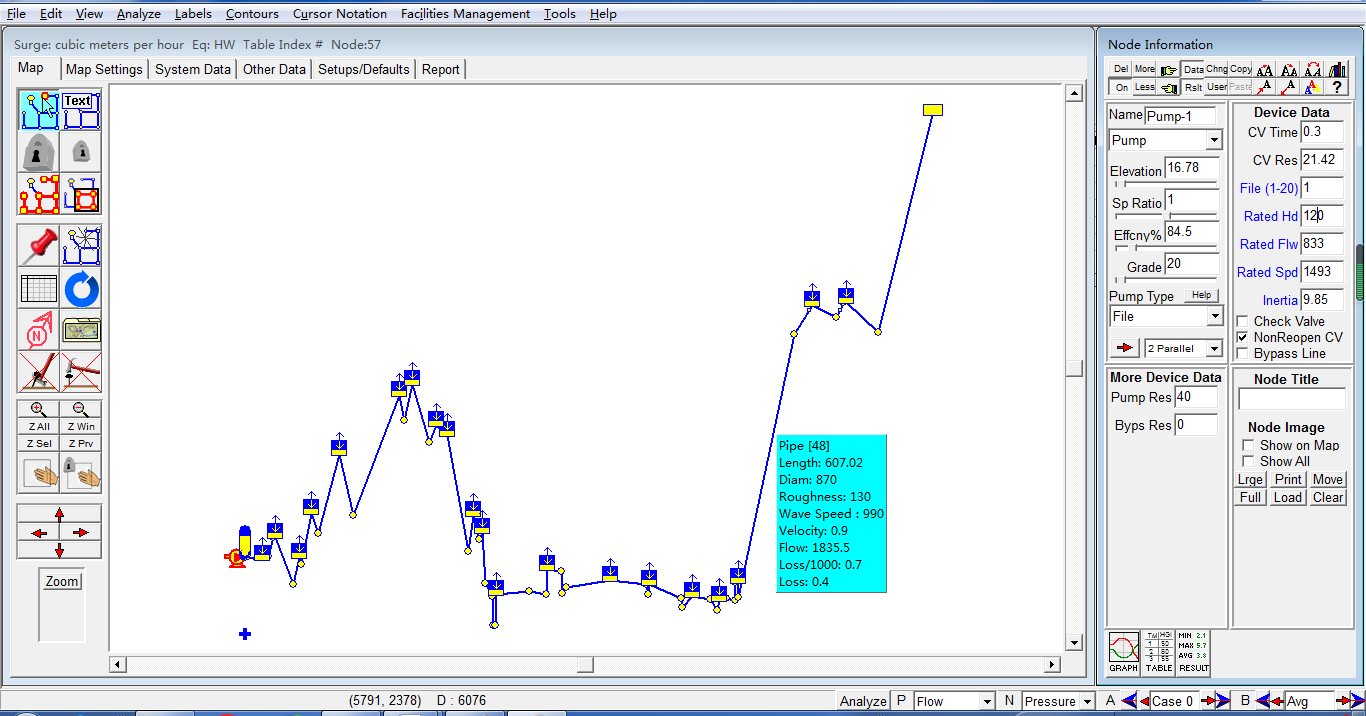
Example model build from a delivered study
Geometry
Chainage, bore, material and high points along the whole route.
Pumps
Duty points, curves, rotating inertia and operating combinations.
Boundaries
Reservoir levels, valves and existing protection devices.
The whole line
responds.
A power failure at the pumps can create both vacuum and high rebound pressure. The study locates where each limit is reached and how long the event develops.
These are actual solver outputs from the existing project material; the homepage animation is conceptual.
Protection that has
a specification.
The report identifies the required protection and checks its effect in the model. Recommendations include sizes, positions and operating behavior, not just a device category.
Surge vessels
Volume, pre-charge and connection at the pump station.
Air valves
Type, size and chainage at critical summits.
Valve closing laws
Closure times and sequences checked against the governing event.
Enough detail to
act on.
You receive a laid-out PDF report, model files and tabulated output. The conclusion should be readable by an operator; the calculations remain available to the reviewer.
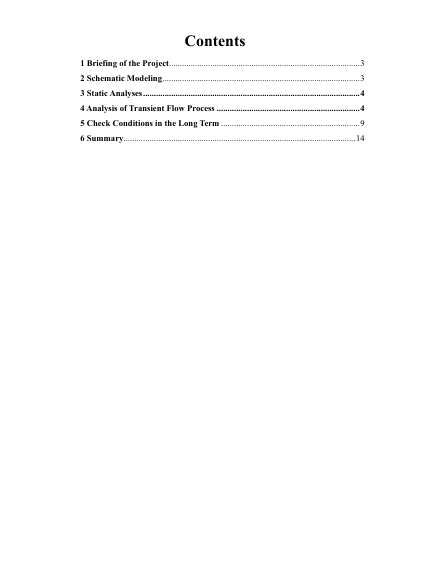
Pages from an example delivered report
Steady state
Pump duty, hydraulic grade and static pressure.
Unprotected
Maximum and minimum head envelopes and critical locations.
Protected
Verified scheme with equipment schedule.
Summary
Plain-language decision and practical commissioning notes.
Scope before
work begins.
The simplest single-pipeline study starts at USD 600. Network systems and additional pump combinations are quoted on top before the study starts.
Focused study
One main, one station and standard transient scenarios.
From USD 600Multi-system scope
Several mains, pump combinations, branches or complex protection.
QuotedReview
Independent check of assumptions, model build and protection sizes.
From USD 350Get the data
in one place.
The input sheet covers pump data, boundaries and pipeline profile. It gives the study a faster, clearer start.